AudiOasis: Turning a Music Analysis Engine into Tools for Discovery and Curation
Over 2.5 years, I developed a personal music experiment into a working product for exploring my collection and building playlists. The work spans audio analysis, interaction design, a custom design system, and AI-assisted development.
AudiOasis brings two tools together: Music Match, which finds tracks with related sonic qualities, and Mix Maker, which sequences groups of songs into playlists that I can shape and revise.
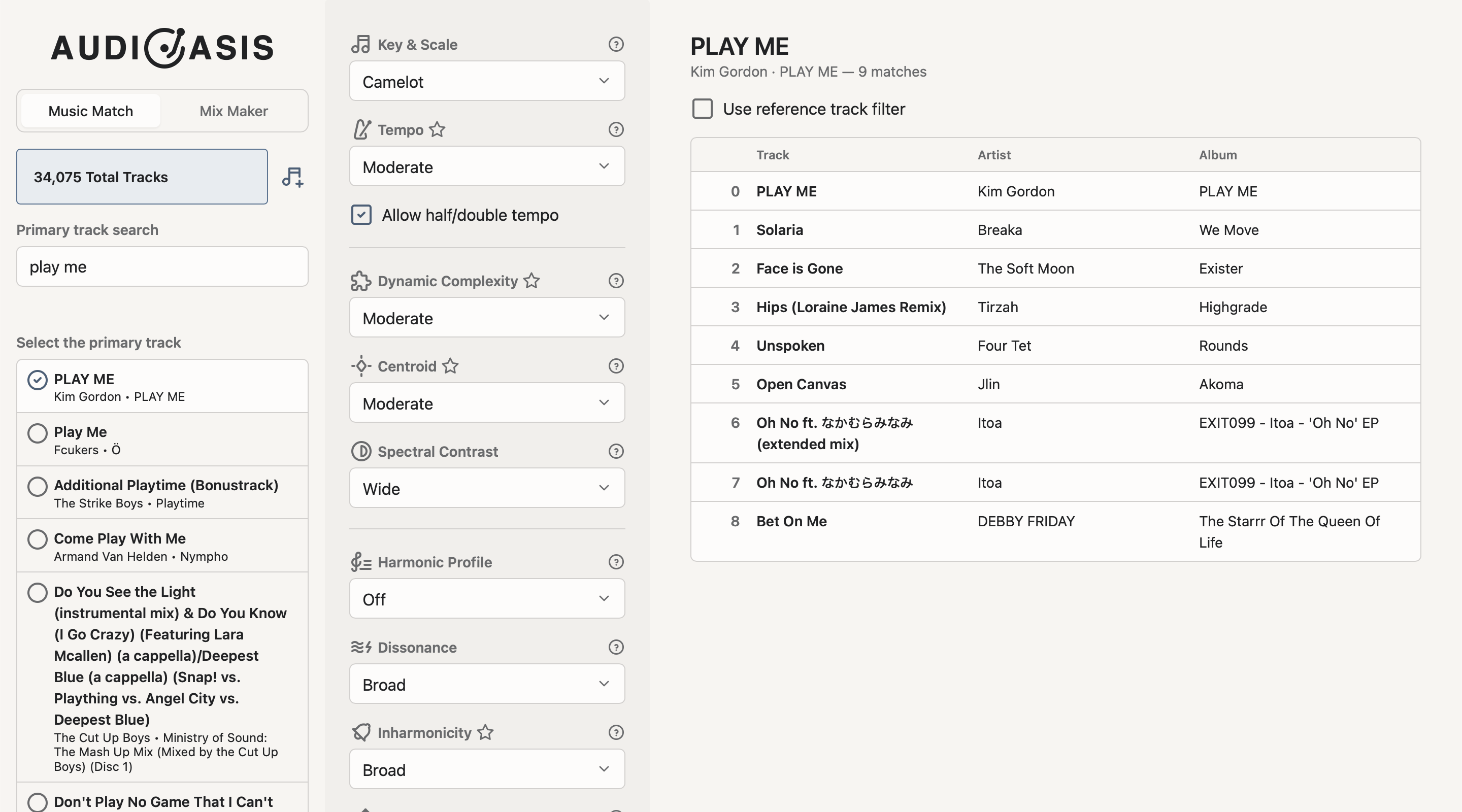
Music Match combines track search, adjustable filters, and related-track results.
My role and the product today
This is a personal project. I own the product decisions, audio-analysis engine, interface, design system, and engineering. I used ChatGPT for early research and development, then Claude Code as an implementation partner as the product evolved.
The application runs locally alongside my Roon library of nearly 35,000 tracks. It grew from early experiments in 2024, through the TrackMatch and Micro-Set Playlist prototypes in 2025, into AudiOasis in 2026.
Across those versions, I kept returning to the same design question: how could the software help me discover musical connections while leaving room for listening, taste, and choice?
Starting with a collection and a question
Music has been central to my life since my teens. I own the music in my library and use Roon to organize and explore it. That collection reflects what I want to listen to, independent of streaming catalogs, and includes many recordings unavailable on those services. I wanted to find connections within it that went beyond genre or popularity.
I began with a single track: what else in my library might fit beside it? My first experiments used Spotify's audio features and ChatGPT to reconcile metadata and explore matches. The results were inconsistent. Conversations lost track of parameters, and the available data did not cover the full collection.
That changed how I used AI. I began using it to help research and build tools that could analyze the audio directly. The analysis would be repeatable; I would listen to the results and decide what belonged together.
Making musical relationships explorable
Using Essentia and Python scripts developed with ChatGPT, I scanned the collection and stored audio features in a local database. This gave me a foundation for comparing tracks without depending on an ongoing AI conversation.
The first interface, TrackMatch, was built in Streamlit and made those comparisons available through filters. A seed track supplied starting values. I could narrow or broaden the search, choose which attributes mattered, or add a reference track to explore qualities shared by two songs. Harmonic filters let me consider relationships between keys and scales alongside other audio traits.
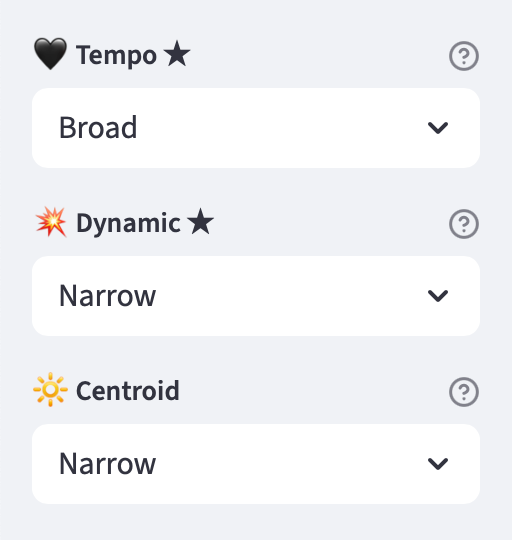
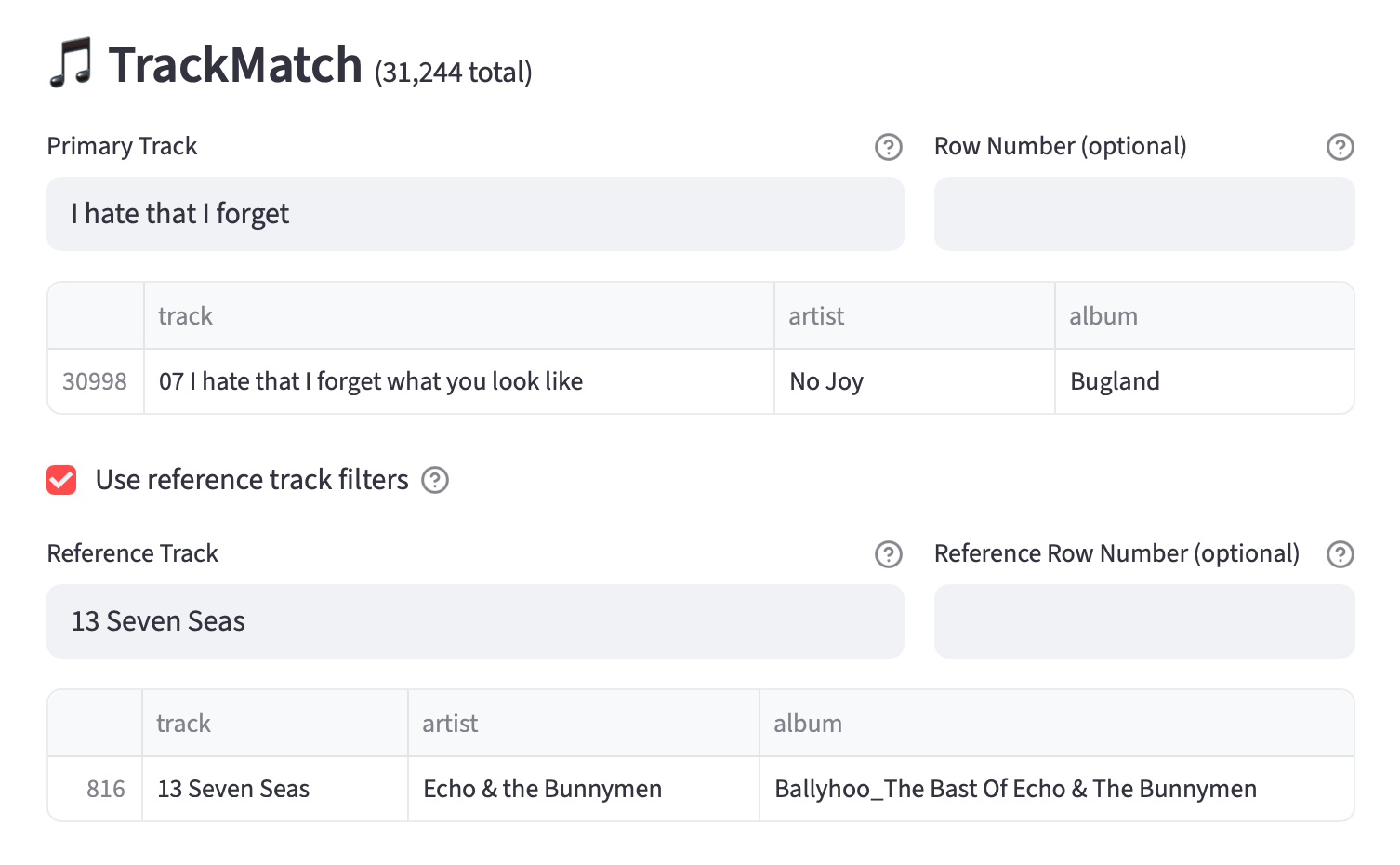
Earlier TrackMatch prototype: adjustable filters and a reference track helped define which musical qualities to explore.
The results were deterministic: the same inputs produced the same matches. That made it possible to adjust a constraint and understand how it changed the candidates. I auditioned the results in Roon and assembled three-song groups, or microsets.
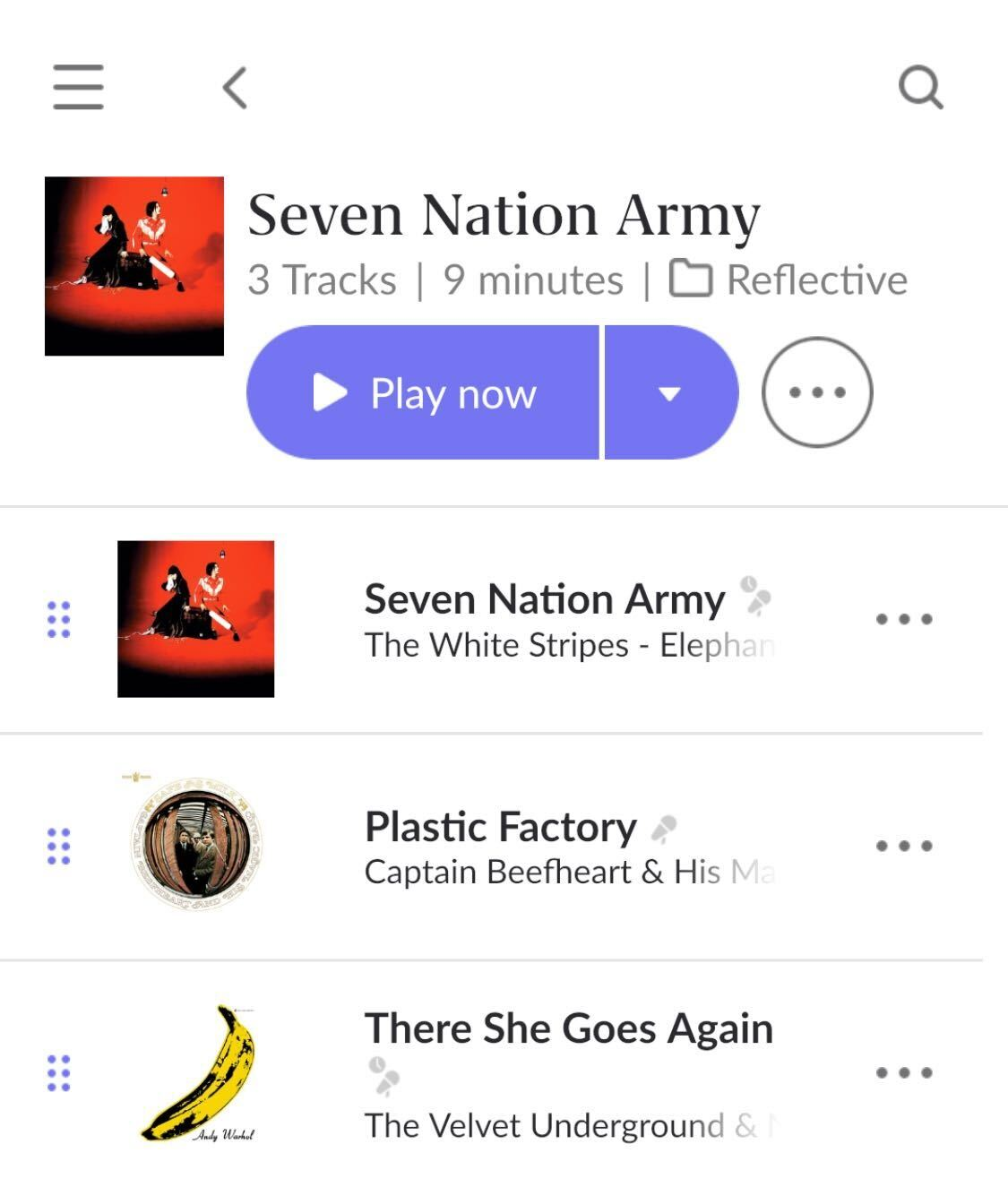
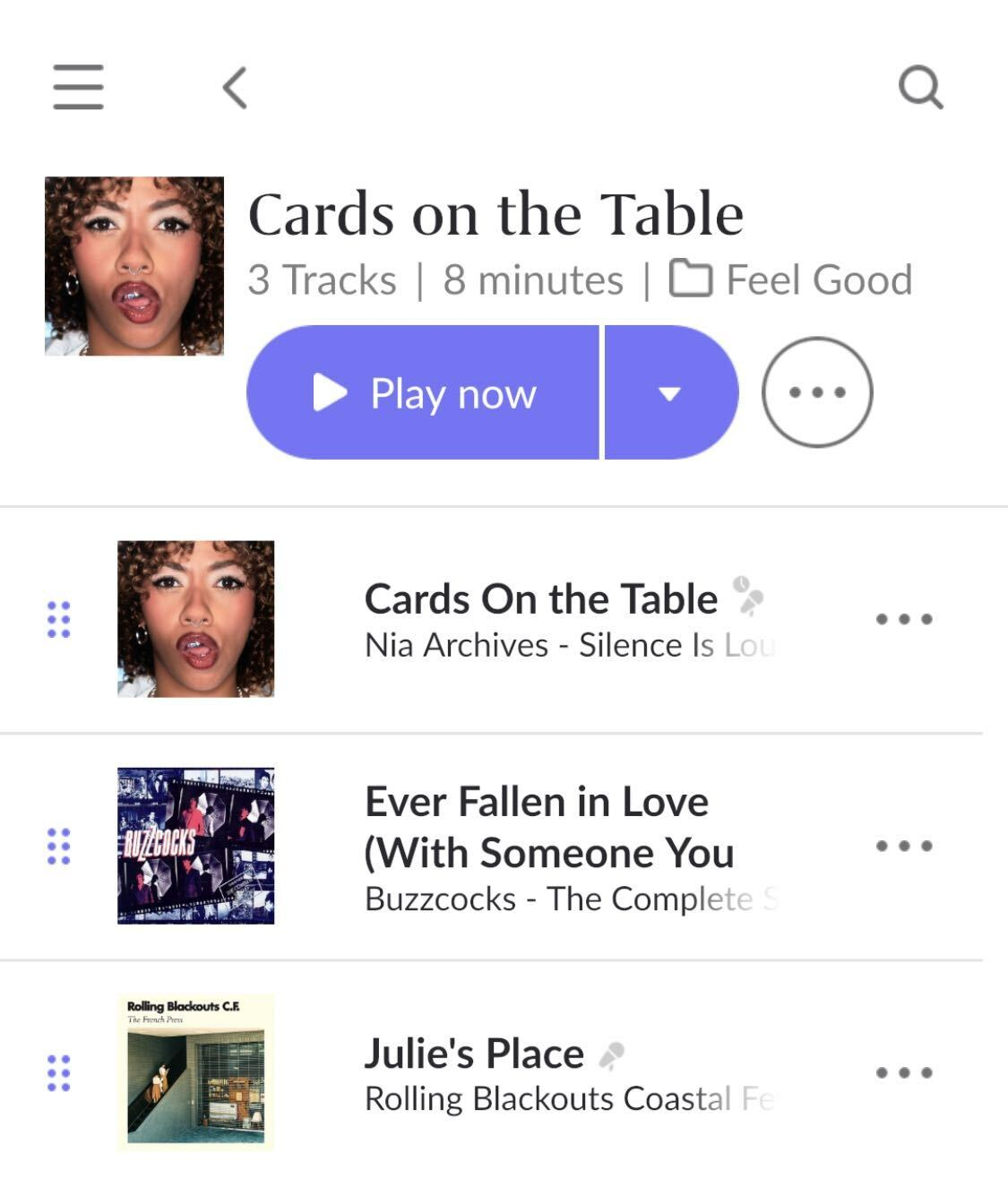
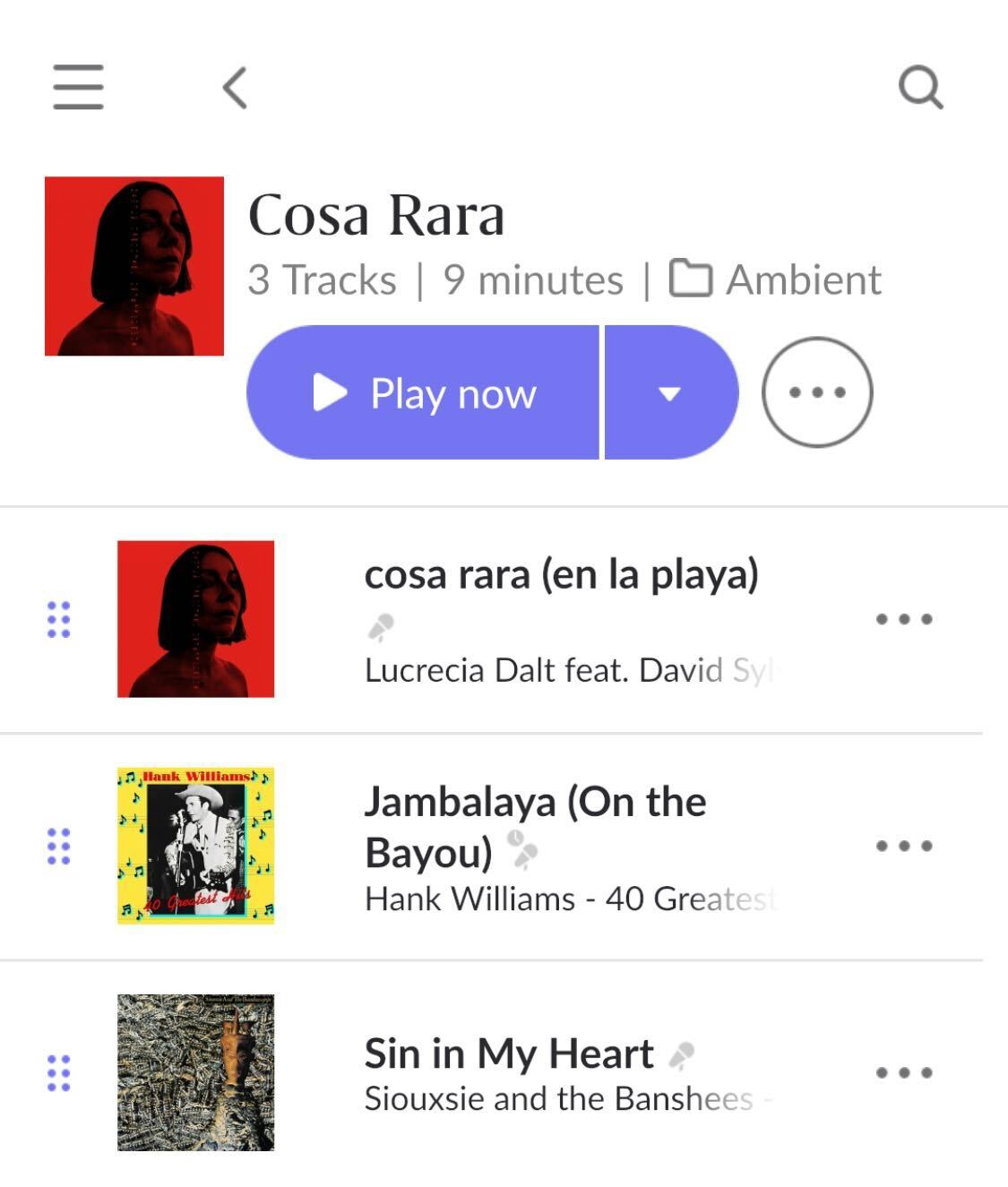
Three-song micro-sets assembled and auditioned in Roon. Roon is the listening environment, not an interface I designed.
Those groups became the building blocks for a second tool. The Micro-Set Playlist app organized them by energy and valence, then followed paths through those themes to create longer listening sequences. It gave me a way to explore the emotional shape of a playlist while preserving the smaller groups I had curated.
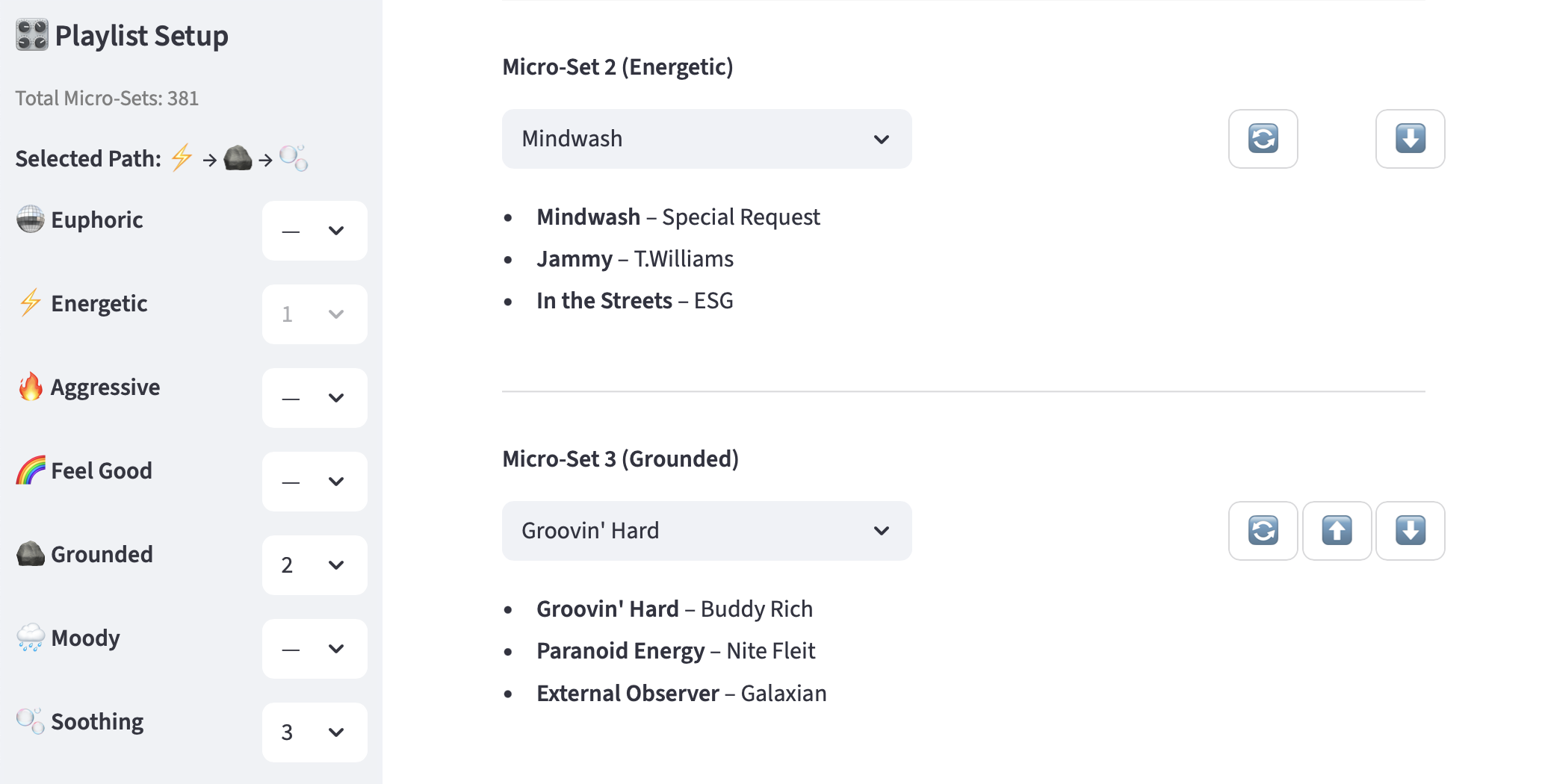
The earlier playlist tool organized the sequence around a selected path through emotional themes.
Building a design system for the next version
Streamlit helped me explore the matching and sequencing ideas, but its layout and component conventions limited how I could shape the experience. For AudiOasis, I wanted control over typography, components, and interactions while retaining the Python analysis and matching logic.
I built a separate design system before building the new application. Its foundation was a set of tokens authored in code and reflected into Figma Variables and Styles. The same decisions could inform design exploration and the working interface.
Connecting visual decisions to implementation
The system separates primitive values, semantic roles, and component tokens. Components reference semantic decisions, so their appearance follows a shared structure rather than a collection of local styling choices.
Color uses semantic roles and perceptual ramps. Typography has explicit scale and weight tokens. A mapping layer keeps the names used in Figma aligned with those used in CSS.
The system's component experiments were built in Vue, while AudiOasis uses Flask, htmx, and Alpine.js. Shared CSS tokens allowed the application to use the design foundation across that difference in technology. I could keep the analysis in Python and develop a custom browser interface around it.
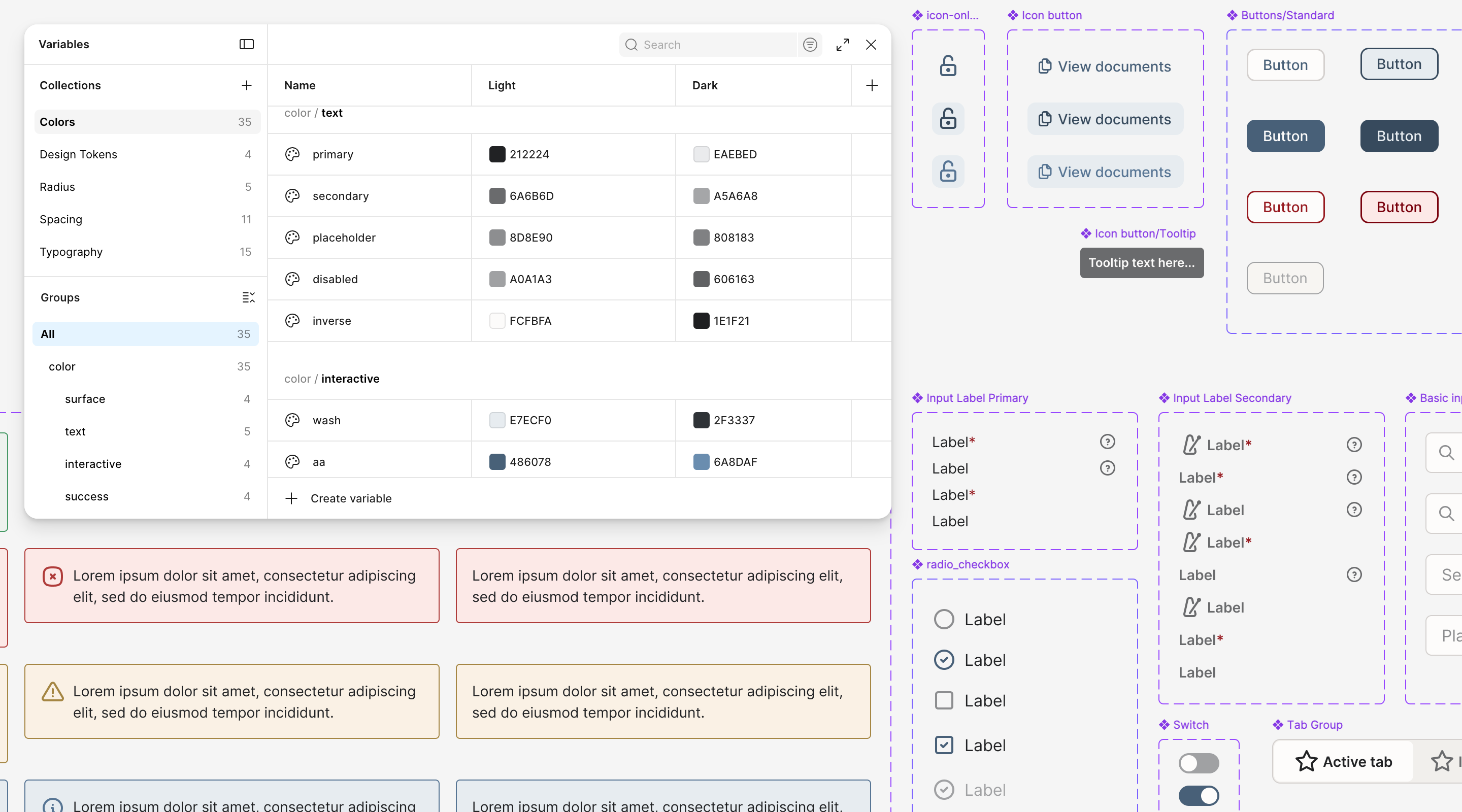
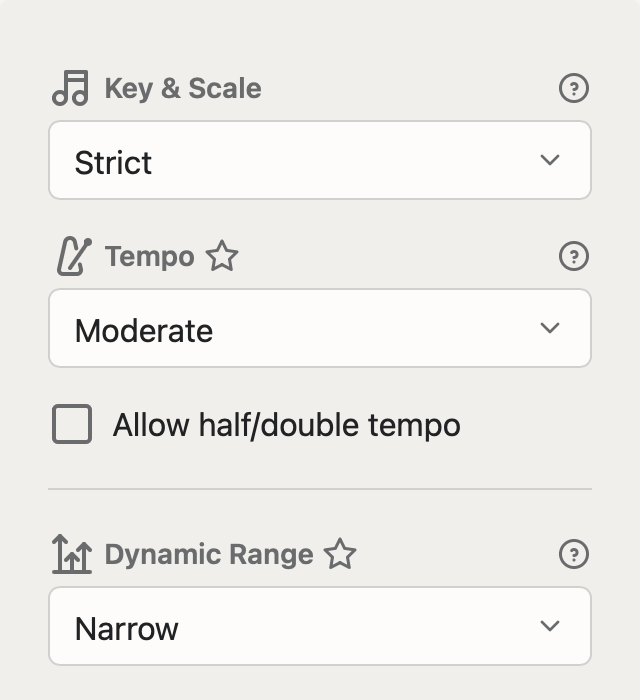
Design tokens and components in Figma, alongside the filter controls in the application.
Giving AI a consistent foundation to work from
I used Claude Code to help implement against the system's conventions. It worked from documented decisions and existing patterns, with instructions to reuse tokens and components.
I reviewed the results in the browser, refined interaction states and responsive behavior, and updated the system when a new pattern was needed. The design work continued through implementation: generated output gave me something concrete to inspect, and the system gave subsequent changes a consistent foundation.
Music Match: carrying the useful interactions forward
Music Match develops the workflow established in TrackMatch: select a seed, explore candidates, and adjust the constraints. Reference-track filtering and harmonic matching carried forward from the earlier tool. The new interface brings those capabilities into AudiOasis's design system, with a focused search flow and a live-filtering results table.
I kept Music Match focused on discovery. It helps me investigate relationships between tracks; playlist sequencing belongs to Mix Maker. This gives each tool a clear purpose while allowing both to share the same underlying analysis and visual language.
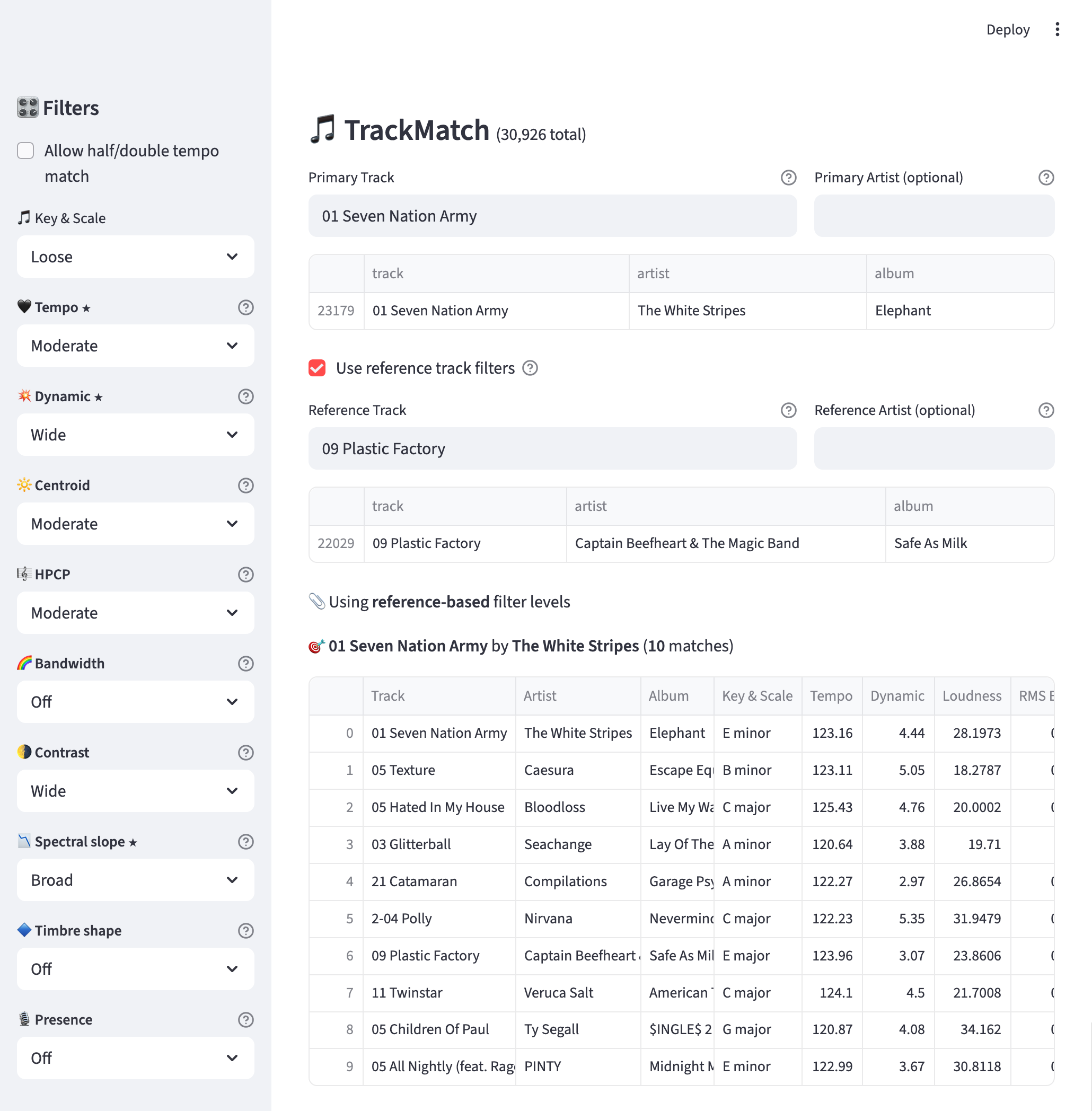
The earlier TrackMatch interface already included reference-track filtering and harmonic controls. Music Match carries those capabilities into the custom interface shown at the top of this page.
Mix Maker: shaping a playlist while leaving room to explore
I wanted to give playlists a recognizable shape while leaving room for unexpected connections. Broad sonic themes helped group microsets with related characteristics and distinguish them from sets that sounded very different.
Research into partimenti, a tradition of teaching composition and improvisation through bass-line patterns, gave me an analogy for shaping a playlist: establish a character, move away from it, and return. I adapted that idea into Home, Depart, and Return as a structure to explore through listening, rather than a proven rule for sequencing songs.
I treated the transitions between sets as a separate design problem. Within the playlist's broader structure, the system evaluates how the last track of one microset connects to the first track of the next.
The interface lets me shape the overall playlist and refine individual transitions. I can preserve selections I like while exploring alternatives, or relax an individual join when it leaves too few choices. That keeps the generated playlist open to revision without requiring me to loosen every constraint.
I also made the system's limitations visible. A slot stays empty when no set fits its section, and a connection is marked as forced when it falls below the available Join Quality levels. Those signals let me see where the sequence needs attention and decide what to change.
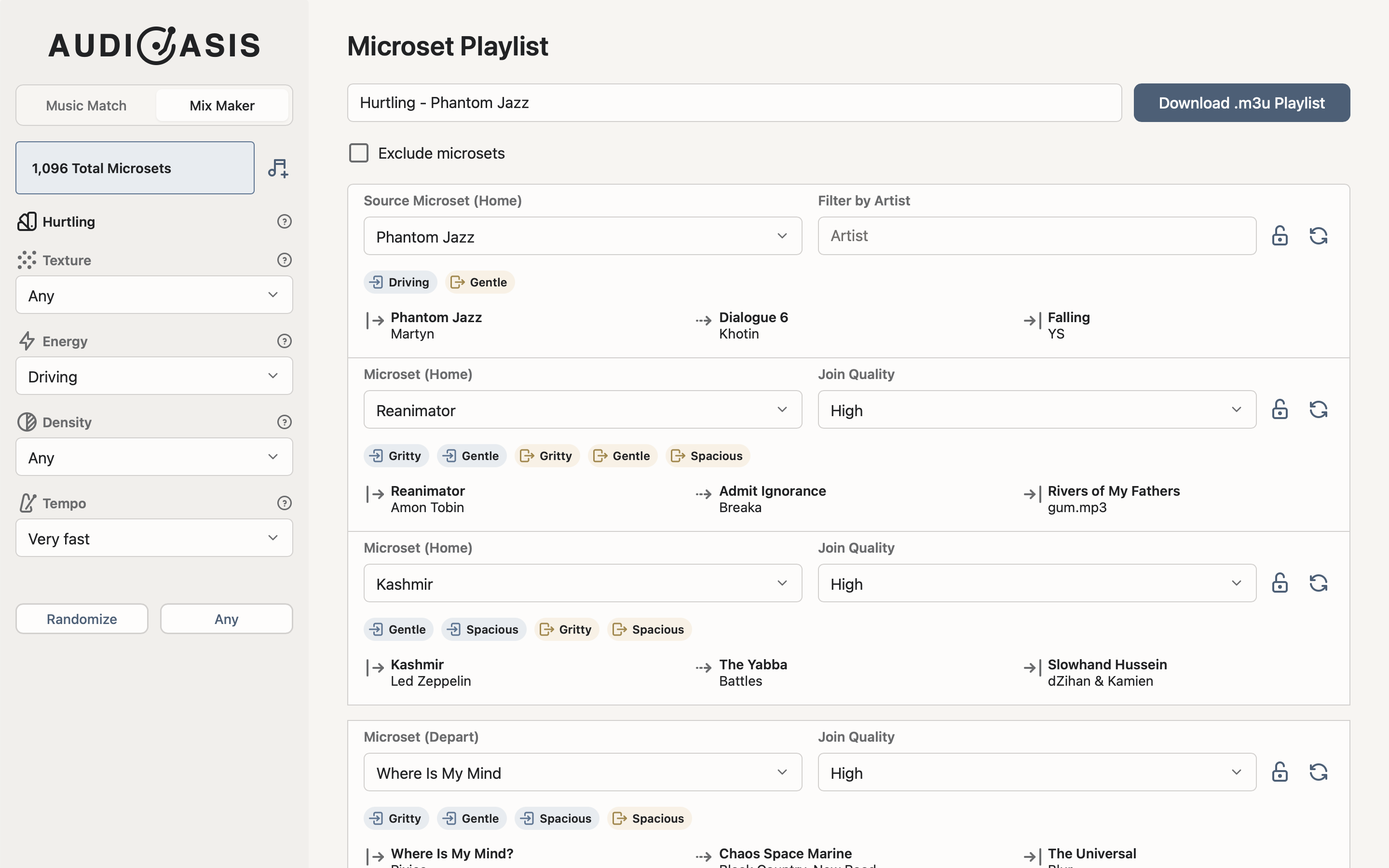
Home, Depart, and Return shape the playlist, while selection locks and individual join controls let me refine it.
Making the product easier to maintain
The earlier workflow required separate exports, scripts, imports, and restarts. I brought the import steps into the application so I could keep the tools current as my collection changed.
Music Match imports new track analysis. Mix Maker imports Roon exports and rebuilds the information needed for sequencing. Both use the same upload interaction, with feedback about what happened, allowing me to continue working inside the product.
This extended the design beyond searching and generating playlists to the routine work needed to keep those features useful.
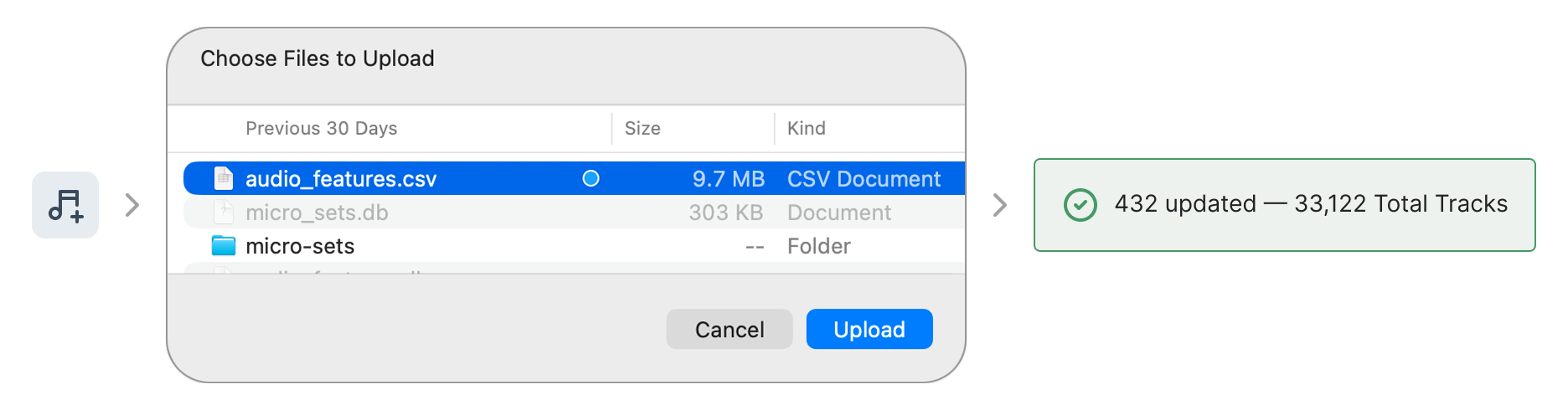
Importing new analysis and confirming the update without leaving the application.
What the project demonstrates
AudiOasis is a product I use with my own collection. That sustained use has given me opportunities to refine the model, the interface, and the workflow over time. It is not evidence of broader adoption or of the same value for other listeners.
The project brought my work across research, interaction design, design systems, and implementation into one continuous process. Building the tools let me investigate ideas directly; using them gave me reasons to revise both the underlying logic and the experience around it.
The most important progression was in how the software and the listener work together: repeatable matching for exploration, a shared system for the interface, and controls that let people preserve and reshape what automation produces.